
Why ±0.03mm vs ±0.08mm Actually Matters on Your Parts
Every Industrial robot specifications sheet has a repeatability number, and most buyers skim right past it. It sits between “payload” and “reach” — two numbers that are easy to picture — while repeatability, listed as something like Robot repeatability ±0.03mm or Robot repeatability ±0.08mm, sounds like a rounding error. It isn’t. On a real production line, that single number is often the difference between a weld that passes inspection every time and one that needs rework on a percentage of parts.
What repeatability actually measures
Repeatability isn’t accuracy in the sense most people assume. It’s not “how close does the robot get to the exact point I programmed” — it’s “how consistently does the robot return to that same point, run after run, thousands of times.” A robot can be taught a slightly imperfect path and still be extremely valuable, as long as it returns to that same slightly imperfect path every single time. What kills weld quality isn’t a small error — it’s an inconsistent one.
Think of it like a dart player who always hits two inches left of the bullseye versus one who scatters darts randomly around the board. The first player is more useful — you can adjust your aim once and every throw lands in the same spot. That’s repeatable.
Where the difference shows up on the floor
The gap between ±0.03mm and ±0.08mm looks tiny on paper. On the shop floor, it shows up in specific, costly ways:
- Seam tracking on tight joints. Thin-gauge sheet metal and tight-tolerance assemblies have very little margin for the torch to drift off the seam. A few hundredths of a millimetre of variation can mean the difference between a clean fillet weld and one that undercuts or misses the joint edge on some fraction of parts.
- Consistency across a long run. A robot with looser repeatability might weld the first fifty parts perfectly and start drifting on part three hundred as thermal expansion and mechanical wear accumulate. Tighter repeatability specs give you more margin before that drift becomes visible in the weld.
- Multi-pass and multi-layer welds. Where a program lays down several passes on the same joint, each pass needs to land in almost exactly the same place as the last. Loose repeatability compounds across passes.
- Fixture wear tolerance. Fixtures aren’t perfect forever — they wear, they get bumped, they get re-clamped slightly differently. A robot with tighter repeatability gives you more headroom before fixture imperfections translate into weld defects.
How to Compare Robot Repeatability for Your Application
Repeatability only matters relative to your tolerance requirement — it’s not a “bigger number always wins” spec. A robot with ±0.05mm repeatability for welding , Painting, Pick and Place and a heavy structural frame with generous tolerances is more than sufficient. The same robot on a precision aluminum assembly with tight fit-up requirements might be the reason for occasional rejects that a ±0.03mm machine wouldn’t produce.
The practical approach: take your tightest tolerance requirement across the parts you actually plan to run, and make sure the robot’s repeatability spec has real margin under it — not just enough to squeak by, but enough to stay comfortably compliant as fixtures wear and production volumes scale.
Reach and payload tell you what a robot can physically do. Repeatability tells you how reliably it will keep doing it, weld after weld, month after month. It’s the specification that determines whether your rejection rate stays low as volume goes up — which makes it worth more attention than a single line on a datasheet usually gets.
Ready to Automate Your Business?
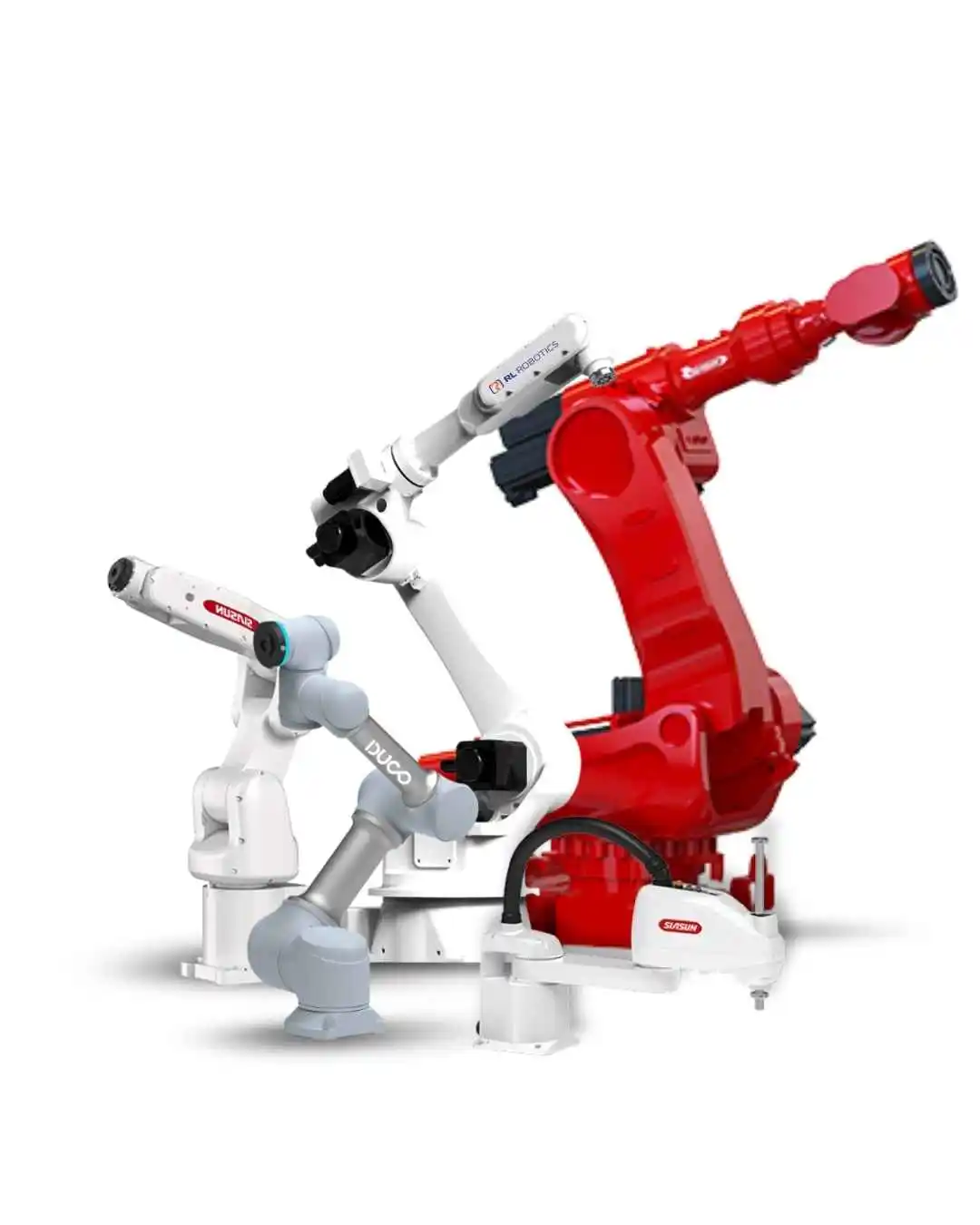
RL Robotics’ industrial robot series spans repeatability from ±0.03mm to ±0.08mm across the Compact Series, and Universal Series, sized to match tolerance requirements from precision assemblies to heavy structural welding, Painting, Pick and Place.
👉 Connect with RL Robotics today
FAq
What is robot repeatability?
Robot repeatability refers to how consistently an industrial robot can return to the same programmed position over repeated cycles.
What is the difference between ±0.03mm and ±0.08mm robot repeatability?
±0.03mm and ±0.08mm represent different repeatability specifications. A robot rated at ±0.03mm has a smaller specified positioning variation than one rated at ±0.08mm.
Does higher robot repeatability always mean a better robot?
Not necessarily. The required repeatability depends on the application, part tolerances, welding process, fixtures, production requirements and overall automation setup.
How should manufacturers choose robot repeatability?
Manufacturers should consider part tolerances, application requirements, welding process, fixture accuracy, production volume and the robot’s overall specifications when selecting repeatability.
Why does robot repeatability matter in welding?
Robot repeatability can affect how consistently the welding torch returns to programmed positions. This can be important for applications involving tight joints, multi-pass welding and repeated production cycles.